
Advanced SEO Insights
Higher-level analysis over data SEO Web Data already collects from your crawls, Search Console and Analytics — built to answer the question every other report leaves open: what should I actually do next. Nothing here claims causation it can't back up.
SEO debt & forecasting
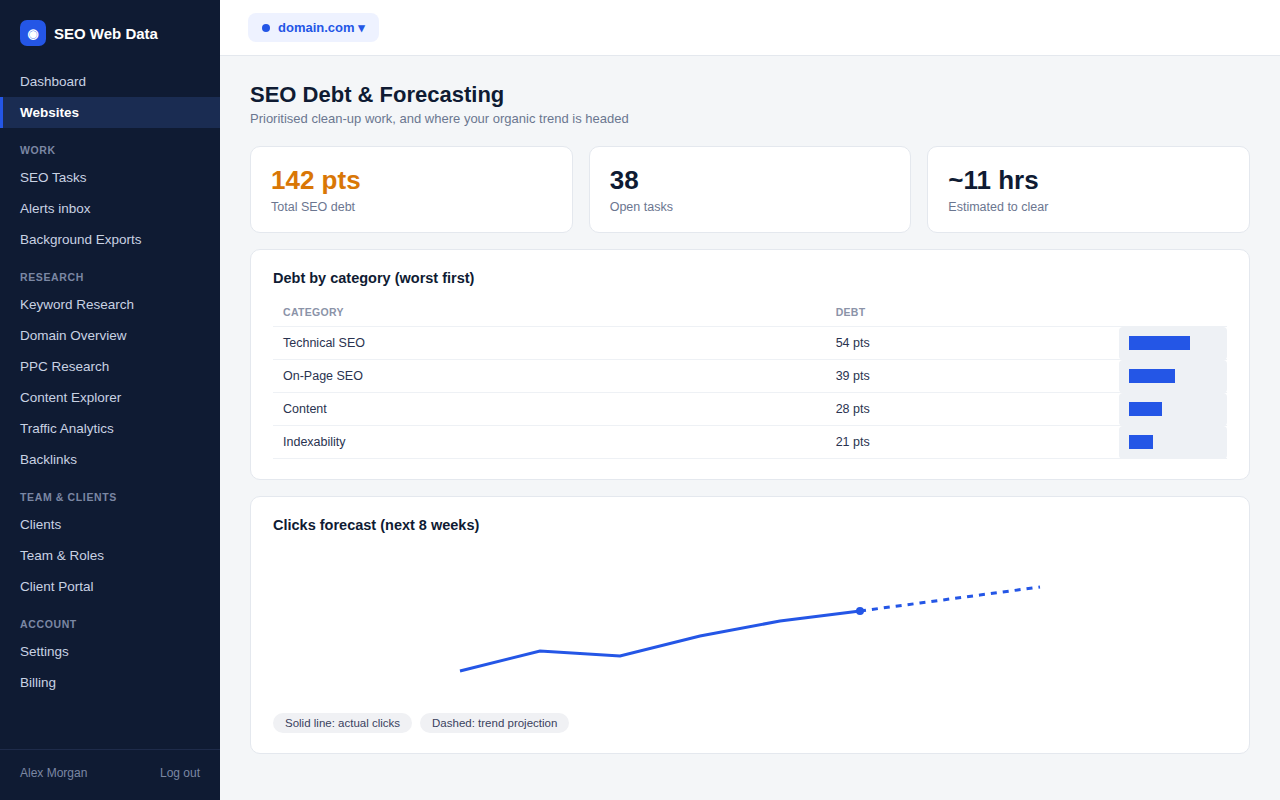
Your SEO score already tells you how healthy a site is. SEO debt takes the same underlying data and reframes it as outstanding work — a total, broken down by category, worst first, with a rough estimate of how many hours it would take to clear. Forecasting takes your Search Console history and projects the recent trend forward, so you can see where clicks and impressions are headed if nothing changes.
- SEO debt total and a per-category breakdown, worst first
- A rough estimated-hours-to-clear figure per category
- A dashed trend projection over recent Search Console clicks and impressions
Brand vs non-brand search performance
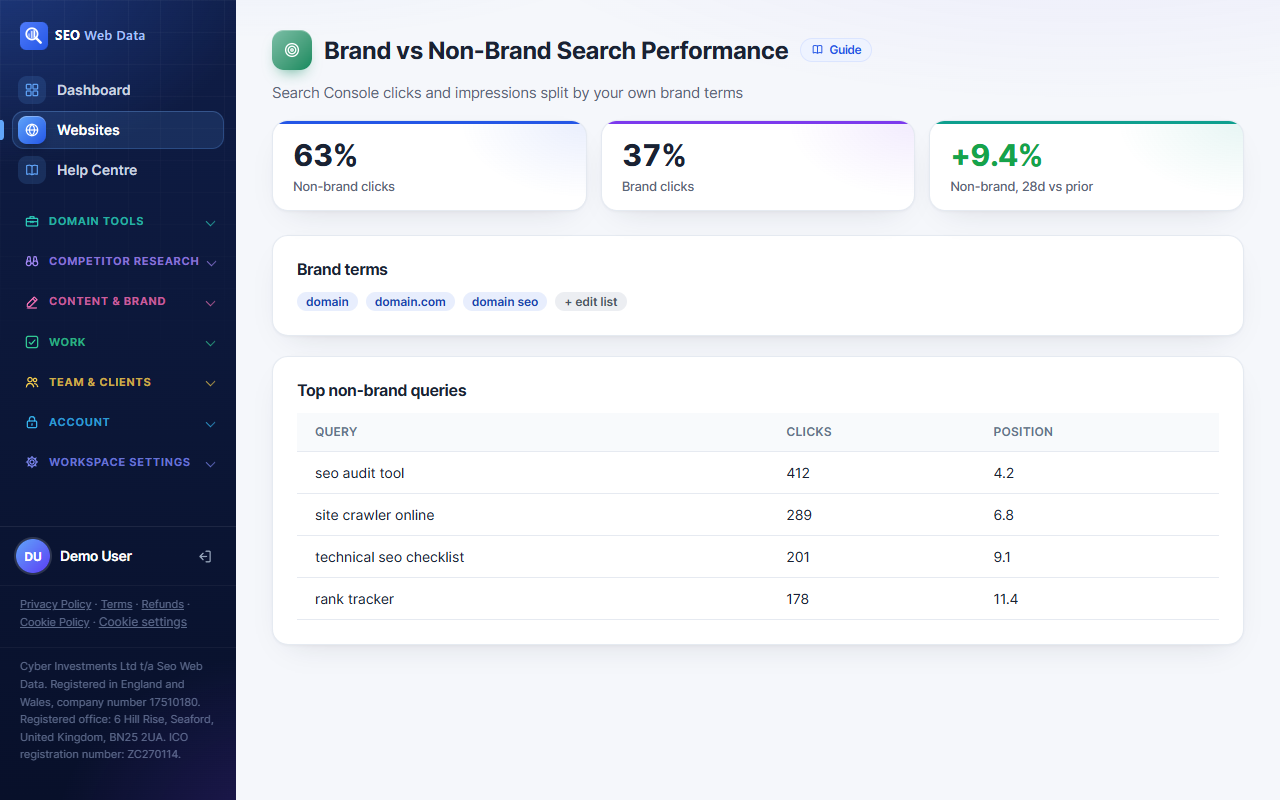
Not every click in Search Console means the same thing. Someone searching your brand name already knows who you are; someone searching a generic term is discovering you for the first time. This splits your synced Search Console data by a short, editable list of your own brand terms so you can see genuine non-brand growth separately from brand searches that would likely happen anyway.
- Clicks and impressions split into brand vs non-brand
- An editable brand-terms list, pre-filled with a sensible starting guess
- Top non-brand queries and their current position
Sitemap & Google reality checks
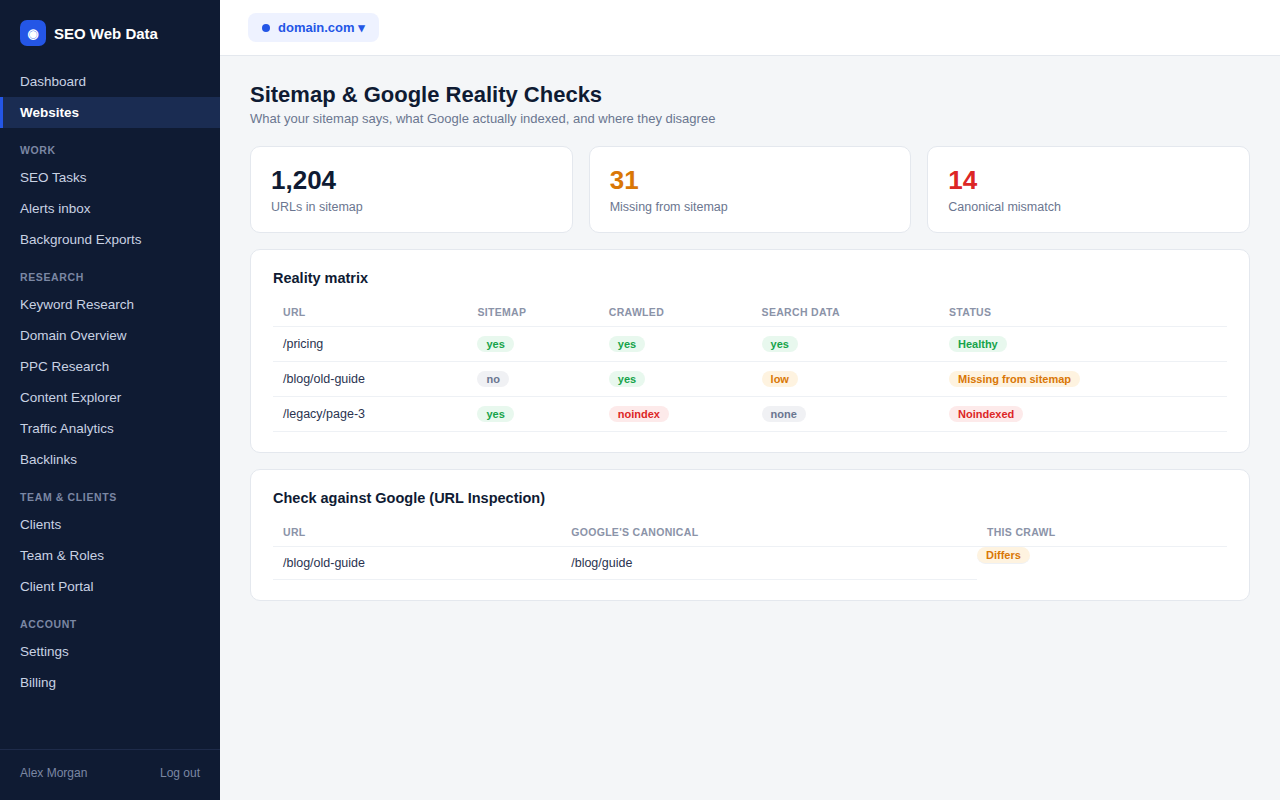
Your sitemap, your crawl, and what Google actually does with a page are three different pictures — and they don't always agree. This brings them together into one matrix per URL, and adds an on-demand check against Google's own URL Inspection API so you can see Google's selected canonical and real indexing status, not just what your site declares.
- One matrix row per URL: in sitemap, crawled, receiving search/analytics data
- Plain classifications — healthy, missing from sitemap, noindexed, not ranking, no recorded visits
- On-demand "Check against Google" for a page's real indexing status and selected canonical
Query mismatch & search intent drift
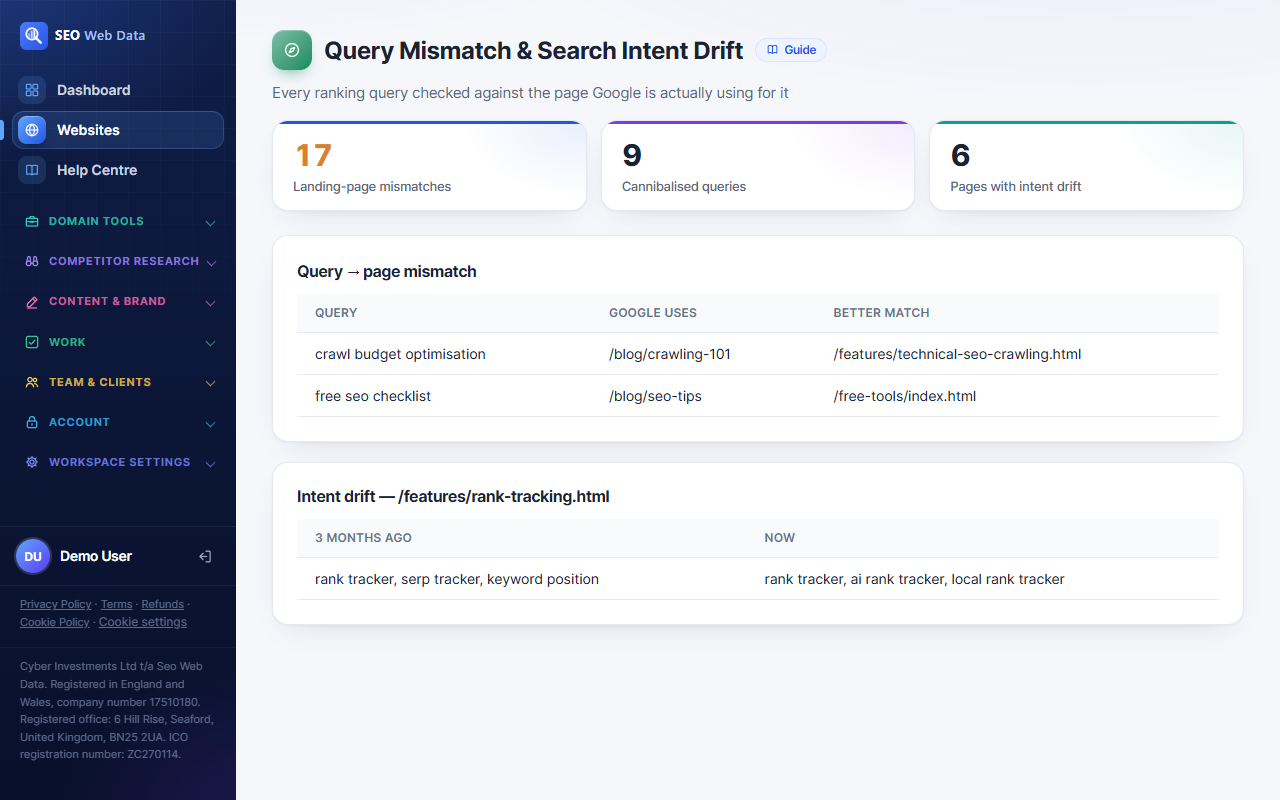
Keyword cannibalisation tracking already flags manually tracked keywords competing against each other. This goes further, sweeping every query in your synced Search Console data — not just the ones you're tracking — to catch landing-page mismatches and broader cannibalisation, and separately flags pages whose own top-query mix has meaningfully shifted over the last couple of months.
- Every synced query checked against whether a better-matching page already exists on your site
- Query-level cannibalisation across the full query set, not just tracked keywords
- Search intent drift — a page's top queries compared month over month
Release monitor & change correlation
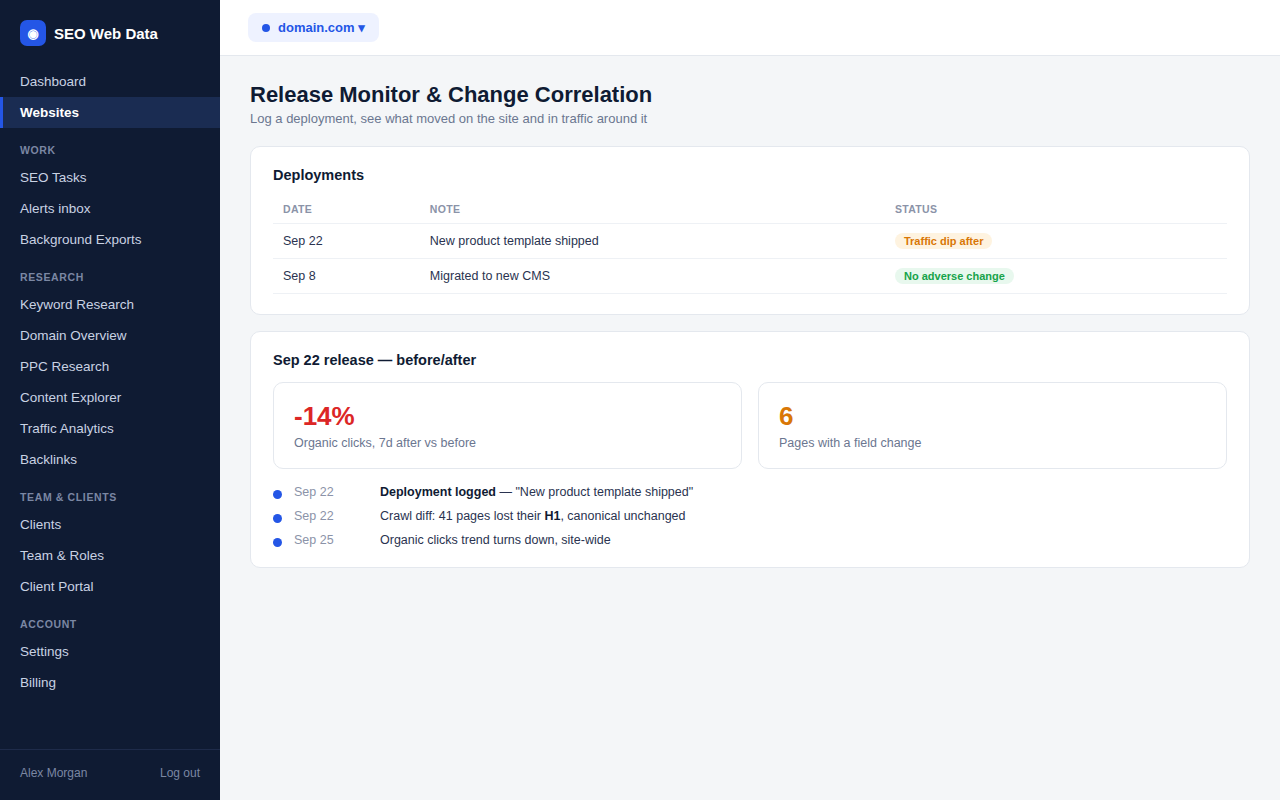
"We deployed changes — did anything move?" is one of the most common questions after a site update, and normally means digging through a crawl diff and a traffic chart separately, by hand. Release Monitor logs the deployment once and brings both views together automatically: what changed in your crawl around that date, and what happened to traffic around it.
- Log a deployment with a note and a date, from a form that can also trigger a crawl
- Automatic before/after crawl diff across the two nearest analysed crawls
- Traffic correlation for the same window, shown side by side — never stated as cause and effect
AI visibility readiness audit
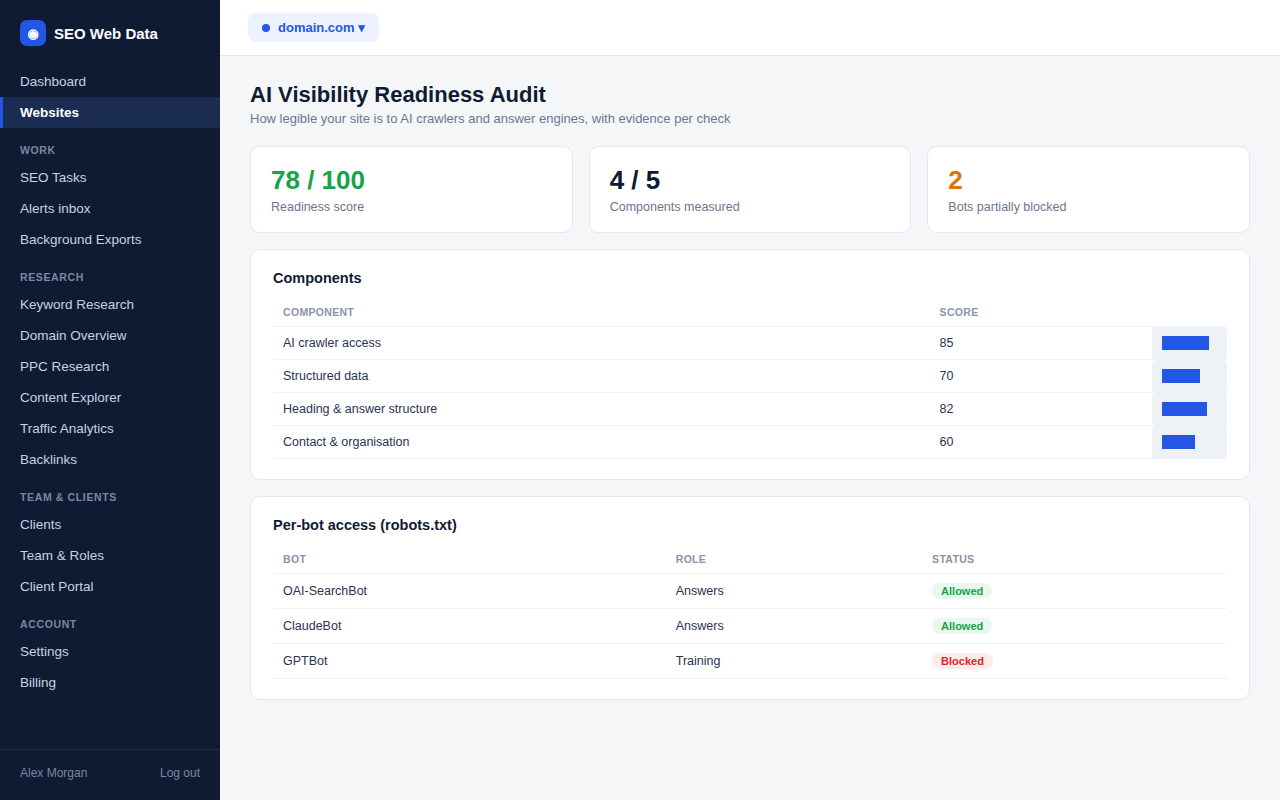
Being cited by an AI answer is one thing; being technically reachable by the crawlers behind those answers is the prerequisite for it. This audit scores how legible your site is to AI crawlers specifically — robots.txt access for named bots, structured data, heading and answer structure, contact and organisation signals, and authorship — each with its own evidence, never a guess dressed up as a number.
- A 0-100 readiness score across five weighted components, each with evidence
- Per-bot robots.txt access for named AI crawlers, split into "answers" and "training" bots
- Unmeasured components are excluded from the score, never counted as a zero
SEO autopsy
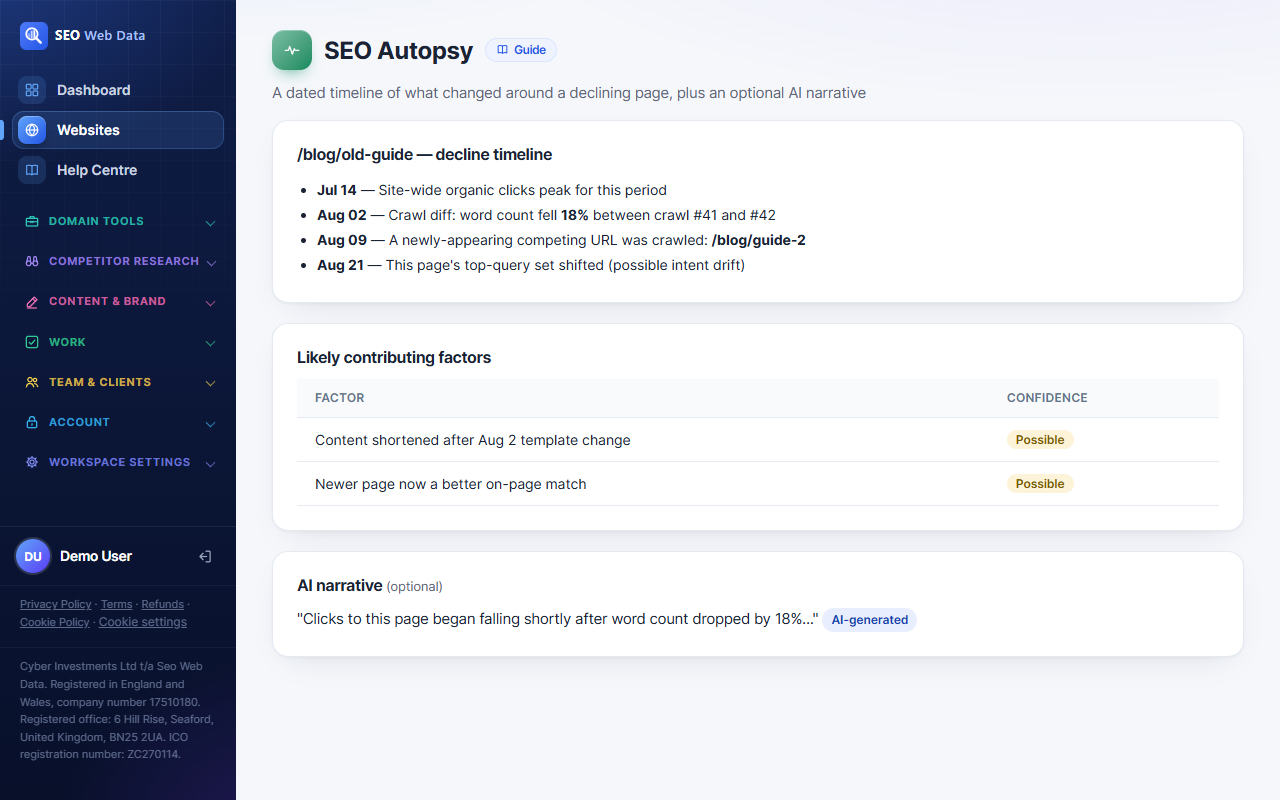
A page in decline raises an obvious question: what actually changed around it? SEO Autopsy answers that for any page already flagged in your declining-pages report, assembling a dated timeline and a list of likely contributing factors purely from facts this app already computed elsewhere — never a generated guess dressed up as analysis.
- A dated timeline built from your crawl history, Search Console data and query snapshots
- "Likely contributing factors", each traceable to one specific stored fact
- An optional AI narrative that puts the same facts into plain prose — never introduces a new one
These sit alongside the opportunities worth acting on already surfaced from your Search Console data, and the SEO change detection that watches for site changes as they happen.