
SEO debt & forecasting
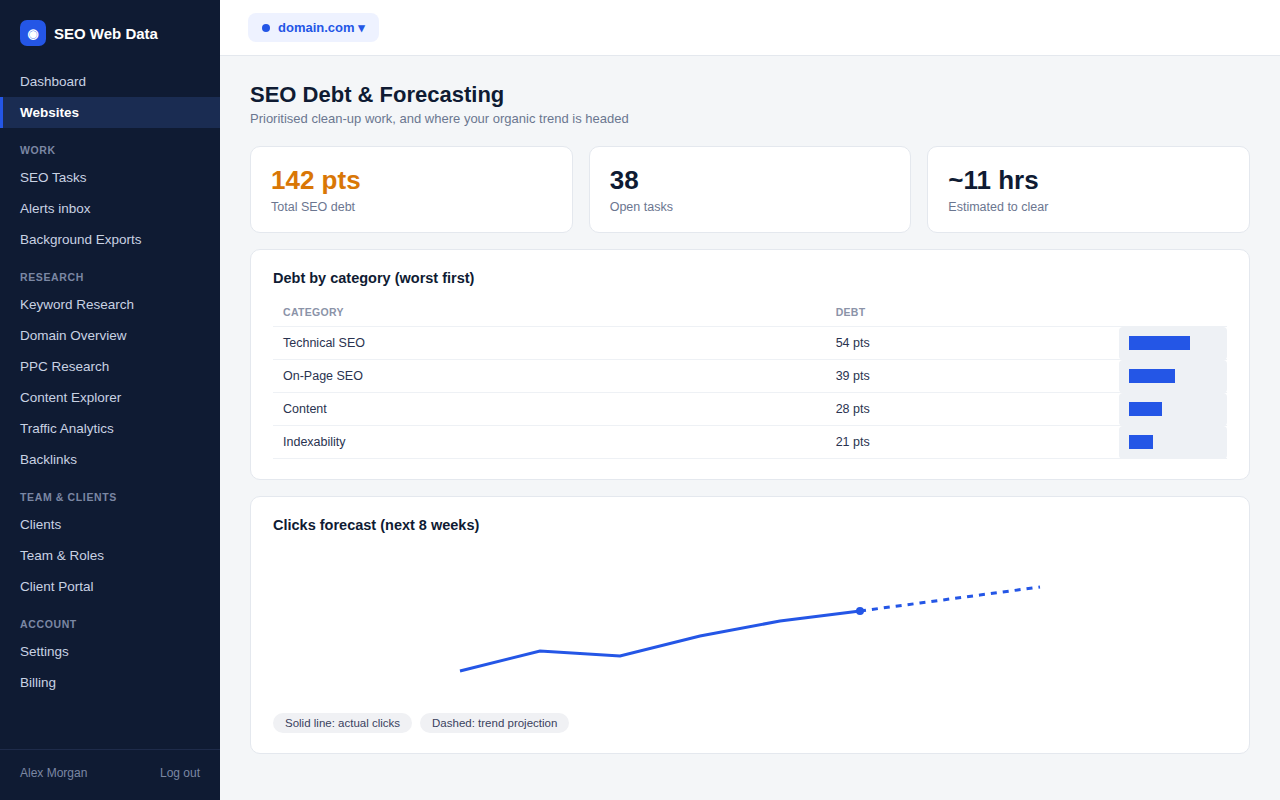
Your SEO score already tells you how healthy a site is. SEO debt takes the same underlying data and reframes it as outstanding work — a total, broken down by category, worst first, with a rough estimate of how many hours it would take to clear. Forecasting takes your Search Console history and projects the recent trend forward, so you can see where clicks and impressions are headed if nothing changes.
What's included
- SEO debt total and a per-category breakdown, worst first
- A rough estimated-hours-to-clear figure per category
- A dashed trend projection over recent Search Console clicks and impressions
Your SEO score already tells you how healthy a site is. SEO debt takes the same underlying data and reframes it as outstanding work — a total, broken down by category, worst first, with a rough estimate of how many hours it would take to clear. Forecasting takes your Search Console history and projects the recent trend forward, so you can see where clicks and impressions are headed if nothing changes.
How it works
SEO debt isn't a new scoring model — it's the existing SEO score's own category breakdown and action plan, presented as "debt" instead of a percentage. The categories worst-affected float to the top, each with its own task count and a config-driven estimate of how long clearing it would roughly take, so a team can plan clean-up work the way they'd plan any other backlog rather than staring at one abstract number.
Forecasting is a straightforward trend line — an ordinary least-squares fit over your recent daily Search Console clicks and impressions, drawn as a dashed continuation of the real, solid line. It only appears once there's enough history behind it, and it always carries a fixed disclaimer: it's a projection based on the recent trend, not a ranking prediction. Nobody — including us — can predict where Google will actually rank you next month, and this never pretends otherwise.
Why it matters
A raw score tells you how you're doing; debt and a forecast tell you what to do next and roughly what it costs to get there. Framing outstanding SEO work as debt makes it easier to prioritise against other engineering and content work using language a team already understands, and having a trend line — however honestly caveated — gives you an early read on whether the direction you're headed in is the one you want, well before a monthly report would show it.
Both live alongside the transparent SEO score & fix list and the Search Console report they're built from, so nothing here duplicates data collection — it's the same facts, organised for a different decision.
SEO debt draws on the same checks as Site Audits & Technical SEO; the forecast draws on Google Search Console data once it's connected.
Frequently asked questions
Is SEO debt a different score from my SEO score?
No — it's the same score and category breakdown, presented as outstanding work (100 minus the score) instead of a percentage, so it's easier to plan clean-up against.
How is "estimated hours to clear" calculated?
It's a rough, configurable per-category estimate meant for planning, not a guaranteed time — actual effort depends on your team, your CMS, and how many pages are affected.
Is the forecast a ranking prediction?
No. It's an ordinary trend line drawn forward from your own recent Search Console data, shown dashed and labelled as a projection, not a prediction of where Google will rank you.
What if I don't have enough history yet?
The forecast simply doesn't show until there's a minimum amount of daily data behind it, rather than drawing a misleading line from too little data.