
Sitemap & Google reality checks
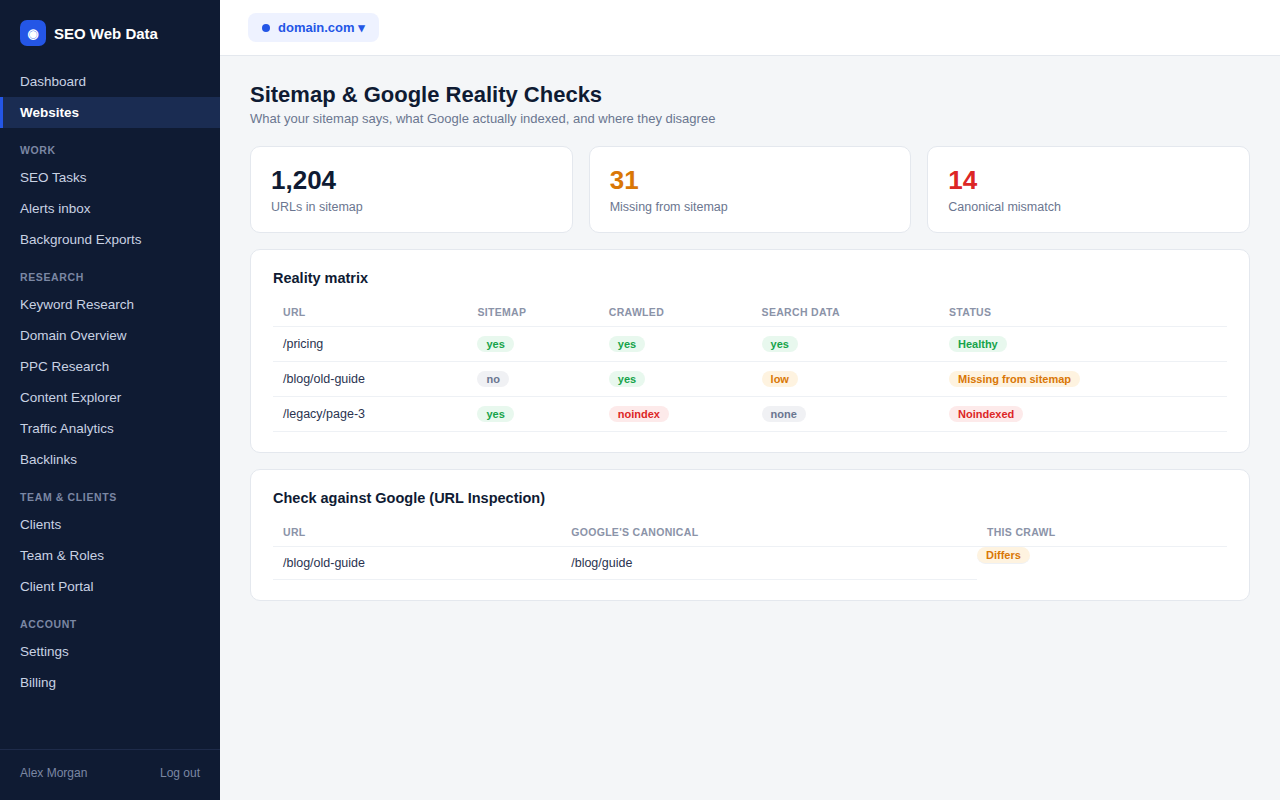
Your sitemap, your crawl, and what Google actually does with a page are three different pictures — and they don't always agree. This brings them together into one matrix per URL, and adds an on-demand check against Google's own URL Inspection API so you can see Google's selected canonical and real indexing status, not just what your site declares.
What's included
- One matrix row per URL: in sitemap, crawled, receiving search/analytics data
- Plain classifications — healthy, missing from sitemap, noindexed, not ranking, no recorded visits
- On-demand "Check against Google" for a page's real indexing status and selected canonical
Your sitemap, your crawl, and what Google actually does with a page are three different pictures — and they don't always agree. This brings them together into one matrix per URL, and adds an on-demand check against Google's own URL Inspection API so you can see Google's selected canonical and real indexing status, not just what your site declares.
How it works
The reality matrix unions every URL your sitemap declares, every URL the crawler actually found, and every URL that's recorded impressions or sessions in your synced Search Console or Analytics data — three sources you're already collecting, brought into one table rather than three separate reports. Each row is flagged present or absent per source and classified in plain language: present everywhere and healthy, missing from the sitemap despite being crawled, noindexed, a crawl error, not ranking, or receiving no recorded visits. Without a Search Console or Analytics connection it simply works from fewer sources — it never invents data to fill the gap.
The URL Inspection check is different: it's the one part of this feature that calls Google directly, through the same Search Console connection already in place. Because Google limits this API far more tightly than its regular reporting data, it only runs when you click "Check against Google" on a specific page, with a local daily limit per website, and the result is cached so re-viewing the same page never spends that allowance twice. It shows Google's own selected canonical and indexing status side by side with what your crawl saw — useful the moment the two disagree.
Why it matters
A sitemap that quietly drifts out of step with your real site — pages added but never listed, old URLs still declared long after they're gone — wastes crawl budget and can leave genuinely new content undiscovered longer than it needs to be. And a crawl alone can't tell you what Google itself decided about a page's canonical or indexing status; only Google can tell you that. Bringing both together in one place turns "I think this page should be indexed" into "here's what Google says it actually did."
This sits alongside the existing technical SEO checks and Search Console report — the same crawl and sync data, one more honest cross-check on top of it.
Builds on the full-site crawler and Google Search Console, connected.
Frequently asked questions
Does building the reality matrix use any extra API calls?
No — it's built entirely from your sitemap, crawl and already-synced Search Console/Analytics data. Only the separate "Check against Google" button makes a live Google API call.
Why is the URL Inspection check limited per day?
Google's own URL Inspection API has a much tighter quota than regular Search Console reporting, so checks are capped per website per day and cached so you never spend the allowance re-viewing the same result.
What does it mean if Google's canonical differs from mine?
It means Google has chosen a different page as the authoritative version for that content than the one your site or your crawl expected — worth investigating, since it can mean the "wrong" page is the one showing in search.
Does this work without a Search Console connection?
Yes, the matrix degrades gracefully to fewer sources (sitemap and crawl only); the Google Inspection check specifically needs a Search Console connection, since it uses that same OAuth link.