
Technical SEO checks
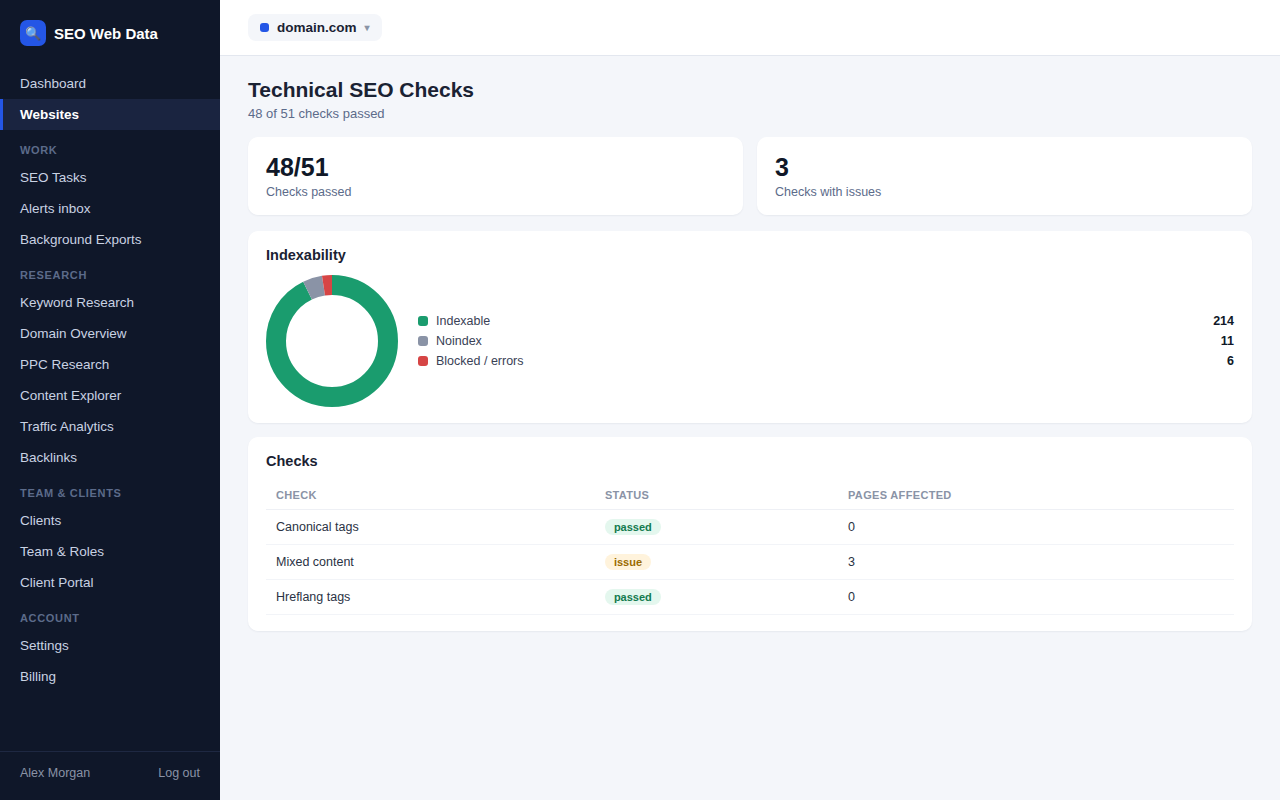
Every page is checked against the technical fundamentals that affect how easily search engines can access, understand and index it: HTTP status codes, HTTPS and mixed content, redirect chains, indexability, canonical tags, and broken internal or external links.
What's included
- Status codes, redirects & canonicals
- HTTPS & mixed-content checks
- Broken link detection
These are the checks that decide whether a page can be found and indexed at all before its content even gets evaluated — a page returning the wrong status code, stuck behind a redirect chain, or accidentally marked non-indexable will never rank no matter how good the content is. Every check runs automatically on every crawl, so a change that breaks something is caught on the next pass, not months later in a traffic report.
Results are grouped by severity so a handful of site-wide issues affecting thousands of pages aren't lost in a long flat list — fixing the highest-impact issue first is usually a few clicks away from the summary.
How it works
Every page found during a crawl is checked against the technical fundamentals that decide whether it can be accessed and indexed at all: HTTP status codes, HTTPS and mixed-content issues, redirect chains, indexability directives, canonical tags, and both internal and external broken links. These checks run automatically on every crawl, so a change that breaks something is caught on the next pass, not months later in a traffic report.
Results are grouped by severity rather than shown as one long flat list, so a single site-wide template issue affecting thousands of pages doesn't get lost among smaller one-off problems.
Why these checks come before everything else
Content quality, keyword targeting and backlinks are all wasted effort on a page a search engine can't reach or won't index — these checks exist to catch exactly that class of problem first. A redirect chain that adds three hops, a page accidentally marked noindex after a template change, or a broken canonical tag pointing at the wrong URL can each quietly remove a page from search results while everything about the page itself still looks fine.
- Redirect chains and loops slow down both crawlers and real visitors, and can eventually break entirely.
- Mixed content warnings on an HTTPS site can trigger browser security warnings that scare visitors off before they ever reach your content.
- Broken external links reflect on trustworthiness in a way that's easy to overlook until a visitor — or a search engine — hits one.
- Structured data errors are flagged alongside the rest, since a broken schema markup can quietly prevent a rich result from ever appearing.
Every check contributes to the technical portion of your overall SEO score, so you can see at a glance whether fixing these issues is actually moving the number.
Frequently asked questions
Are these checks run automatically?
Yes — they run on every crawl without any extra setup once a website is added.
What happens after an issue is found?
Issues can be turned into trackable tasks — see organised work for how a found issue becomes something your team actually works through.
Does this cover on-page content too?
These checks focus on access and indexability; for titles, headings and content-level issues, see on-page SEO analysis.
Can I mark an issue as resolved without fixing it in code?
Issues are re-verified automatically on the next crawl, so the most reliable way to clear one is fixing the underlying page rather than manually dismissing it.