
On-page SEO analysis
Titles, meta descriptions, headings, image alt text, structured data, Open Graph and Twitter tags, and duplicate content are all reviewed automatically on every crawl, so on-page issues are caught before they cost you rankings.
What's included
- Titles, meta descriptions & headings
- Structured data & social tags
- Duplicate content detection
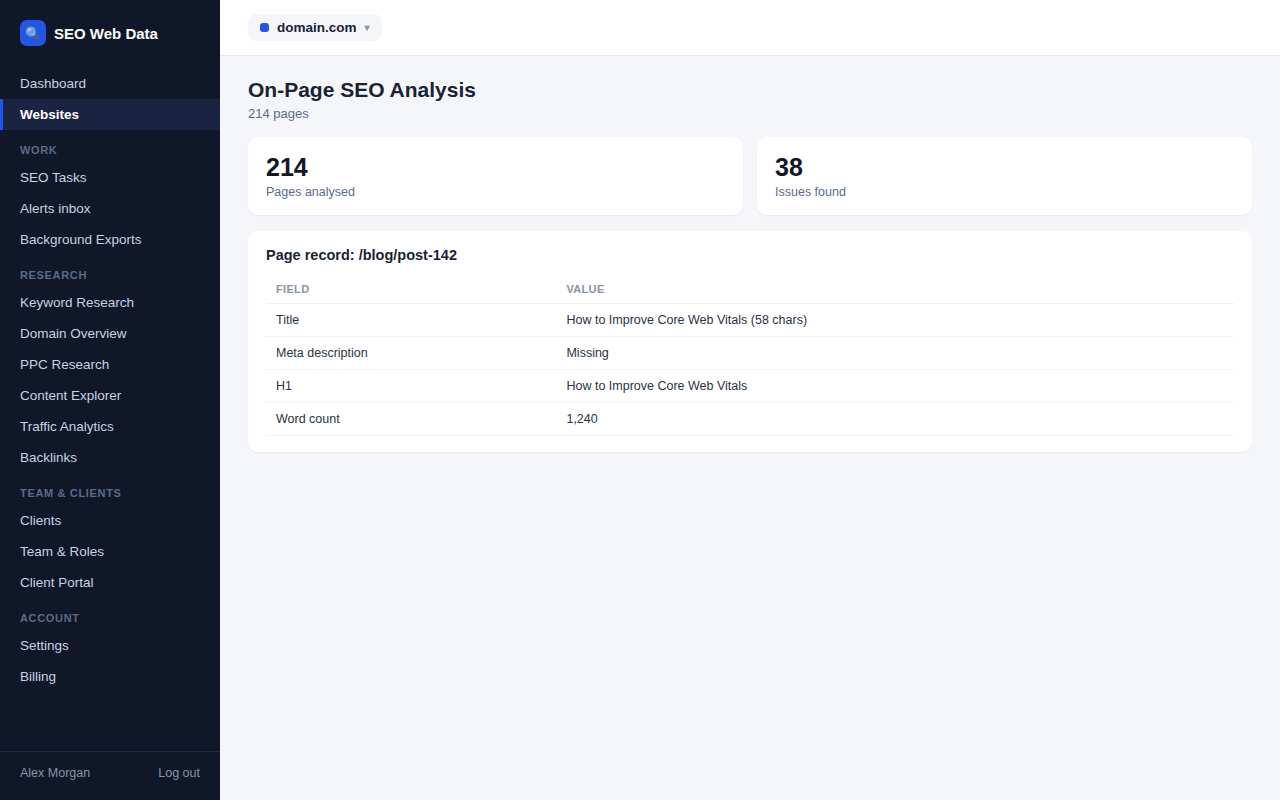
Every page is checked against the on-page basics — a missing or duplicated title, a meta description that's too long, an image with no alt text, a heading structure that skips levels — the kind of small issues that are easy to miss one page at a time but add up across a whole site.
Structured data and social tags (Open Graph, Twitter Card) are validated too, since a broken one can mean a page shows up incorrectly — or not at all — when it's shared or featured in a rich search result.
How it works
Every page picked up by a crawl is reviewed against the on-page basics — titles, meta descriptions, heading structure, image alt text, structured data, Open Graph and Twitter tags, and duplicate content — the details that are easy to miss one page at a time but add up quickly across a whole site.
Each issue is reported against the specific page and element it affects, rather than as a vague site-wide warning, so fixing it means editing one known field, not hunting for the source of the problem first. On a connected WordPress site, several of these fields — titles, meta descriptions and alt text among them — can be applied with one click once you've reviewed the suggested value.
Why the details add up
A missing meta description on one page is a minor omission. A missing meta description on two hundred pages, discovered all at once, is a real content gap that's been quietly costing click-through rate for a long time. On-page analysis exists to catch that pattern early — a duplicated title across product variants, a heading structure that skips from H1 straight to H4, an image with no alt text on every blog post published in the last year.
- Titles and meta descriptions are checked for length, duplication and presence — the fields that show up directly in search results.
- Structured data and social tags are validated, since a broken one can mean a page displays incorrectly, or not at all, when it's shared or featured in a rich result.
- Duplicate content is flagged across pages, which often points at a templating issue rather than anything intentional.
- Content length outliers — pages unusually thin relative to the rest of the site are flagged, often a useful starting point for a content audit.
For deeper, page-specific rewrite suggestions rather than just issue flags, see AI on-page optimisation, which builds on the same underlying page data.
Frequently asked questions
Does this fix issues automatically?
No — it identifies exactly what's wrong and where. On a connected WordPress site, many of these fixes (titles, meta descriptions, alt text and canonical URLs) can then be reviewed and applied with one click; elsewhere, you or your CMS make the edit. For AI-suggested rewrites, see AI on-page optimisation.
How often is this re-checked?
It runs on every crawl, so results reflect your current pages, not a one-off audit from months ago.
Does it check structured data validity?
Yes — structured data and social tags are validated as part of the same review.
Does this check for keyword usage in content?
Yes — keyword presence in titles, headings and body content is part of what’s reviewed alongside the other on-page elements.