
Competitor tracking
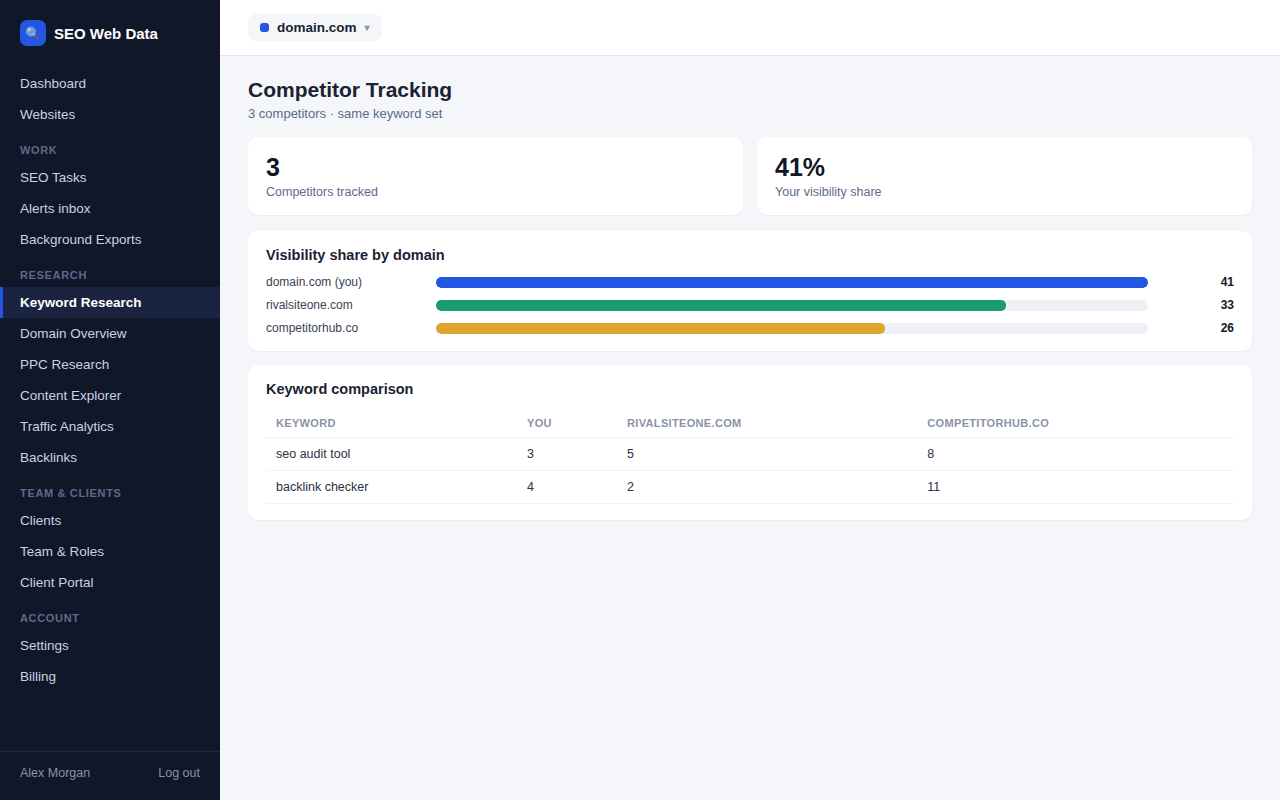
Add the competitors you actually compete with and see how your visibility for shared keywords stacks up against theirs, so you know where you're ahead and where there's ground to make up.
What's included
- Side-by-side ranking comparison
- Visibility trends over time
- Shared-keyword overlap
You choose which competitors to track — there's no attempt to guess who they are — and from then on their visibility for your shared keywords is tracked alongside your own, on the same charts, so a comparison is always one click away rather than a manual exercise.
This is ongoing tracking, not a one-off snapshot: the point is to notice a competitor pulling ahead (or falling behind) while there's still time to react, not to find out at the end of a quarter.
How it works
You choose which competitors to track — there's no attempt to guess or auto-detect rivals — and from that point on, their visibility for the keywords you share is tracked alongside your own keyword rankings, on the same charts and the same schedule, so a side-by-side comparison never requires pulling two separate reports together by hand.
Because tracking is ongoing rather than a one-off snapshot, the same competitor set keeps building history every week — which is what makes it possible to see a rival pulling ahead gradually, not just after the fact.
Why ongoing comparison matters
A one-time competitor check tells you where things stand today; it says nothing about direction. A competitor quietly gaining two positions a week on your five most valuable keywords is a much more urgent problem than one that jumped ahead of you overnight and has been declining since — but you can only tell the two apart with a history to look at.
- Shared-keyword overlap shows exactly which terms you're actually competing over, rather than assuming based on who looks like a competitor.
- Visibility trends make it possible to notice a rival investing heavily in SEO before it shows up as a traffic loss on your side.
- Content and backlink context from competitor intelligence helps explain why a competitor is moving, not just that they are.
- Paid spend context from PPC research shows whether a competitor is also buying visibility for the same keywords they're ranking organically for.
- New entrant detection — a competitor set isn’t static, and reviewing shared-keyword overlap periodically can surface a rival worth adding that wasn’t on the radar originally.
For a look at exactly what a competitor's listing looks like on a given search, pair this with real search result snapshots.
Competitors that outrank you are not always the ones AI assistants recommend. AI share of voice shows how often each rival is named and cited compared with you.
Frequently asked questions
How many competitors can I track?
The number of tracked competitors scales by plan — see Pricing.
Can I change my tracked competitors later?
Yes — the competitor set isn't locked in; you can add or remove rivals as your market changes.
Does this also compare backlinks and content, not just rankings?
For that fuller picture, see competitor intelligence, which tracks the same competitor set beyond just rank position.
Will I be alerted if a competitor overtakes me on a key term?
Significant ranking moves, including a competitor passing you, feed into the same change detection alerts used elsewhere in the dashboard.