
Content audit & gap analysis
See which existing pages are thin, outdated or underperforming, and which topics your competitors rank for that you don't currently cover — so new content and updates are targeted at real opportunities.
What's included
- Thin and underperforming page detection
- Competitor content-gap comparison
- Prioritised content opportunities
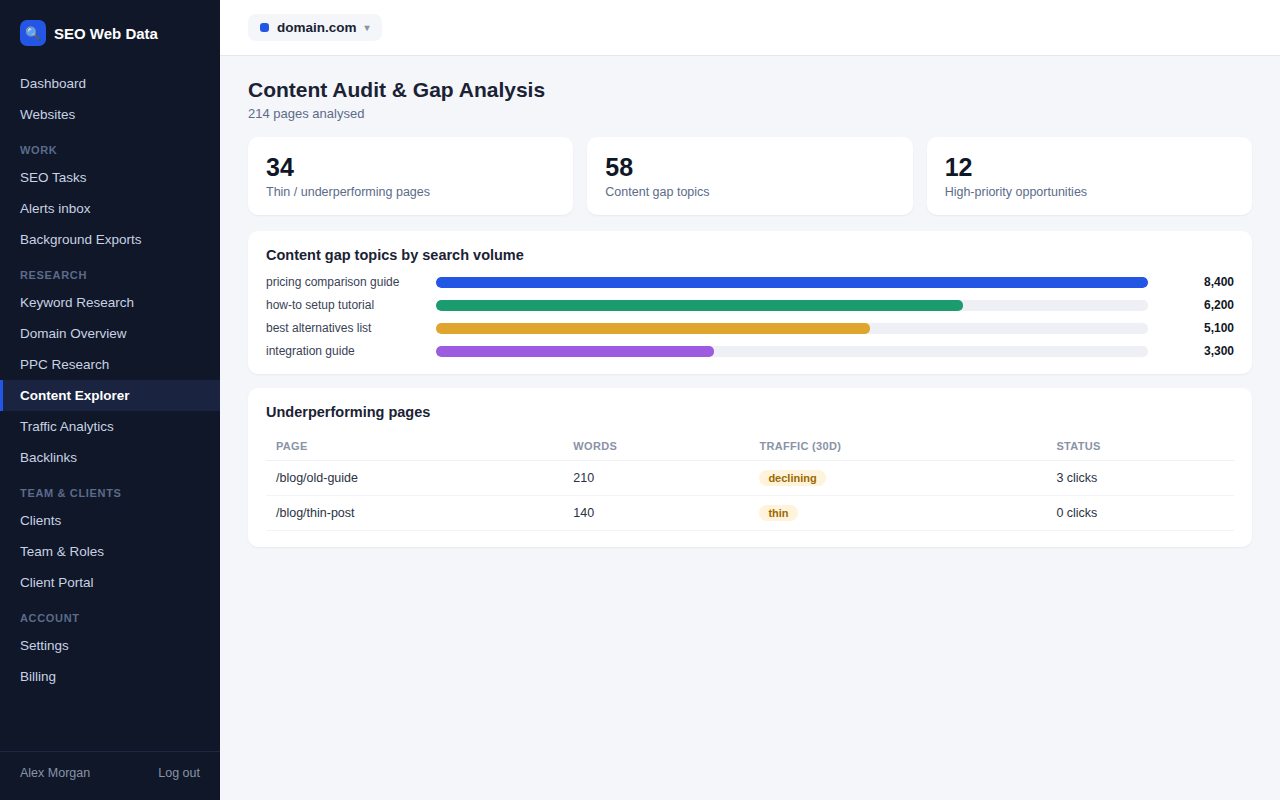
The audit looks at your existing content for pages that are thin, outdated, or simply not pulling their weight relative to how much traffic potential they have — the pages most worth a rewrite rather than a full new article.
Gap analysis compares your content against competitors' to surface topics they rank for that you don't currently cover at all, which is often a faster win than trying to outrank an already-strong competing page.
How it works
The audit reviews your existing content for pages that are thin, outdated, or simply not pulling their weight relative to their traffic potential — the pages most worth a rewrite rather than a brand-new article. Gap analysis then compares your content against tracked competitors to surface topics they rank for that you don't currently cover at all, using the same competitor set as competitor intelligence.
Both outputs are prioritised, not just listed, so the page or topic most worth acting on next is easy to find rather than buried in a long undifferentiated table. To see who already ranks well for a gap topic before committing to write about it, the content explorer shows the top-performing content and estimated traffic for any search first.
Why auditing beats guessing
Most sites accumulate content debt quietly — a page written three years ago for an outdated product, a blog post that never quite found its audience, a category page that's technically live but thin enough to be actively hurting the site's overall quality signal. None of that is obvious from the outside; it takes a systematic pass across the whole site to find it.
- Prioritising rewrites over new content — an existing page with some traffic and backlinks is often a faster win to improve than starting from zero.
- Content gaps as a shortcut — targeting a topic a competitor already ranks for, that you don't cover, is frequently easier than trying to outrank their strongest page directly.
- Feeding the next brief — once a gap or thin page is identified, AI content briefs is the natural next step to plan the fix.
- Cannibalisation checks — the audit can also flag when two of your own pages are quietly competing for the same keyword, which usually needs consolidating rather than a fresh brief.
Gaps also show up in AI answers. The most-cited sources in AI Search Visibility reveal which topics and pages the assistants trust in your market, which is a useful second source of ideas alongside a traditional content audit.
Frequently asked questions
How is "thin" or "outdated" content defined?
The audit looks at word count, traffic trend and age together, rather than any single threshold, to judge which pages genuinely need attention.
Which competitors are used for gap analysis?
The same tracked competitor set used in competitor intelligence — configurable, not fixed.
What do I do once a gap is found?
Generate a starting outline for it directly with AI content briefs.
How often should I run a content audit?
There’s no fixed schedule — many teams run one quarterly, or after a major content push, to keep the picture current without over-auditing.