
AI content briefs
Generate a structured brief for a target keyword or topic — covering suggested headings, questions to answer and related topics — to give writers a head start instead of a blank page.
What's included
- Suggested headings & structure
- Related topics and questions
- Ready to hand to a writer
A brief is generated for a specific target keyword or topic and gives a writer a running start: suggested headings, the related questions worth answering, and adjacent topics readers commonly expect — the planning work done before a single word is written.
Briefs are meant to be handed off, whether that's to an in-house writer or an outside freelancer, so nobody has to start from research each time.
How it works
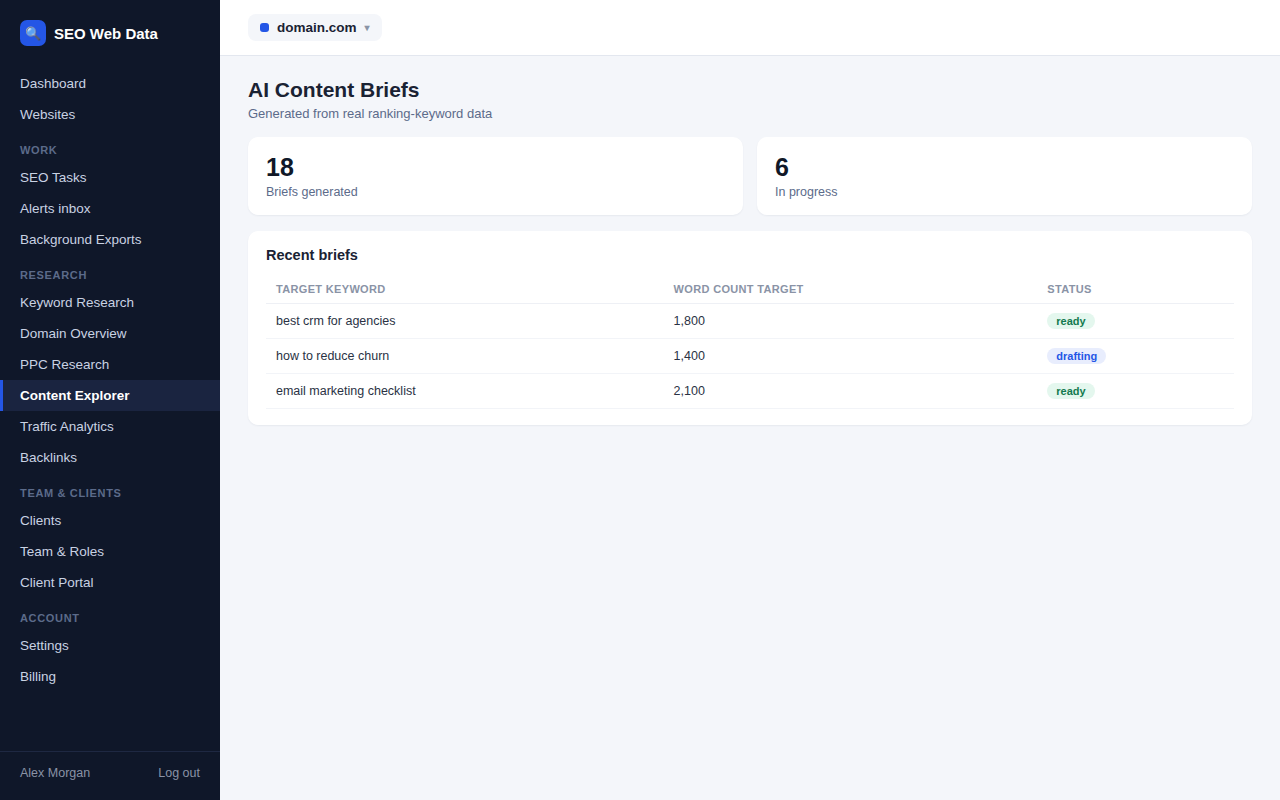
Give it a target keyword or topic, and it generates a structured brief: suggested headings, the related questions worth answering, and adjacent topics readers commonly expect to see covered — the planning work done before a single word is written. Briefs draw on the same ranking and content data used elsewhere in the dashboard, including what's currently ranking for that keyword.
A brief is meant to be handed off — to an in-house writer, an outside freelancer, or used as your own starting outline — rather than kept as an internal-only planning document.
Why briefing before writing matters
Most wasted content effort happens before the first draft, not during it — a writer starting from a blank page has to guess at structure, scope and what's already been covered elsewhere, and those guesses are where an article ends up too thin, off-target, or duplicating a topic you've already published on.
- Faster writer onboarding — a new or freelance writer can start productive work immediately instead of needing a briefing call first.
- Consistent structure — briefs give every piece a comparable shape, which matters once several people are writing for the same site.
- Fewer thin articles — a brief that lists the questions a topic needs to answer makes it harder to accidentally publish something too shallow to rank.
- Target word count guidance based on what’s currently ranking for the topic, so a writer has a realistic sense of depth expected before starting.
Once content is live, content audit & gap analysis is the natural next step — it's what tells you which existing pages might need a brief like this to begin with.
Before you brief a new page, check how AI assistants currently answer the question it targets. AI prompt tracking stores those answers and their sources, so you can see what a page needs to cover to be worth citing.
Frequently asked questions
Does this write the article for me?
No — a brief is the structure and research, not the finished piece. For sentence-level suggestions on an existing page, see AI on-page optimisation.
Can I generate a brief for a topic I haven't written about yet?
Yes — briefs work from a keyword or topic, not an existing page, which is exactly the case they're built for.
How do I know what to brief in the first place?
Content audit & gap analysis and opportunities worth acting on both surface candidate topics worth a brief.
Can I edit a brief after it’s generated?
Yes — a brief is a starting point meant to be adjusted, not a fixed template you have to follow exactly.