
AI Prompt Tracking
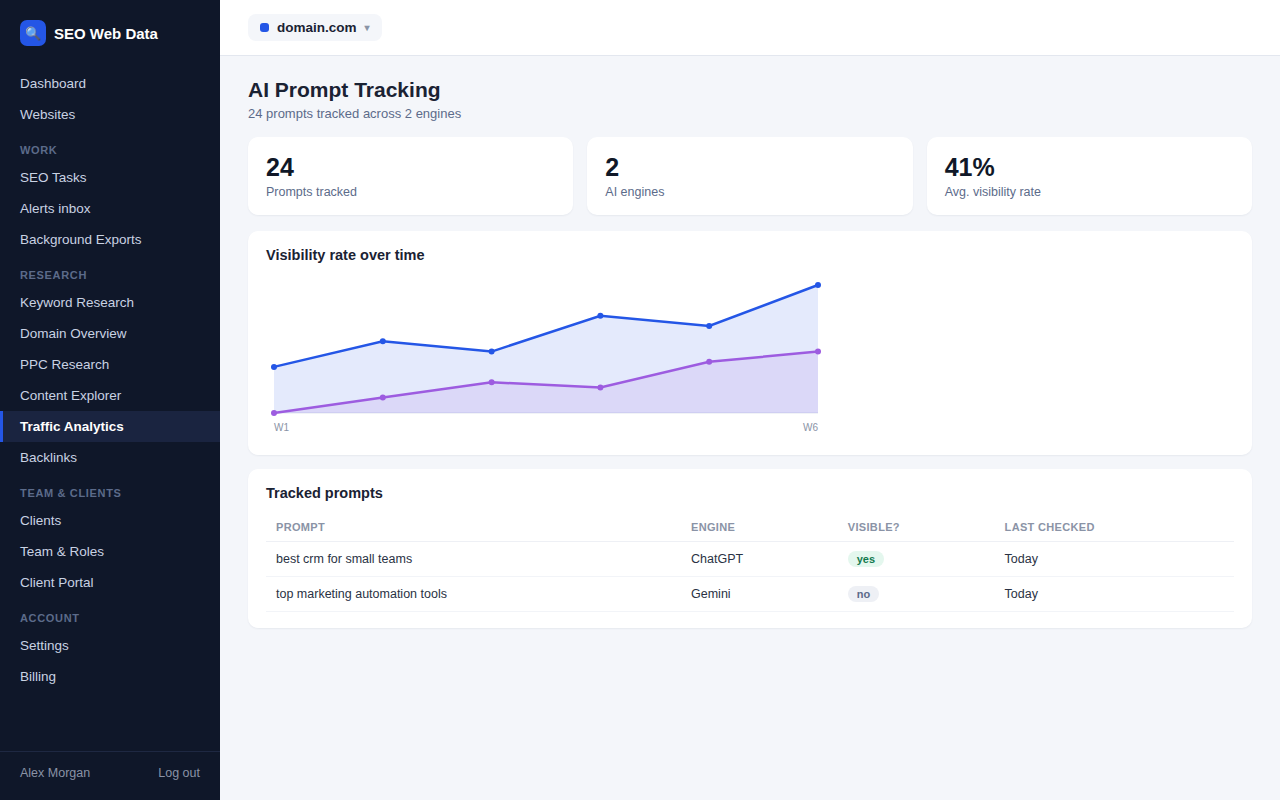
Ask AI assistants the questions your customers ask — automatically, on a schedule — and keep every answer, so you can see how your brand appears and how that changes.
What’s included
- Your own prompts, added one per line
- Prompt ideas generated from your tracked keywords
- Choose the AI engines, country and language
- Manual checks, or automatic daily and weekly runs
Customers no longer type only keywords. They ask full questions: “What’s the best accountant for small businesses in Leeds?” or “Which project tool suits a ten-person agency?” AI Prompt Tracking lets you write those questions down and test them repeatedly, so you know what an assistant tends to say about your market.
Each prompt is sent to the engines you select, the full answer is stored, and the result is read for your brand, your domain and your competitors. Nothing depends on you remembering to check by hand.
Choosing good prompts
The best prompts sound like real customers rather than like search keywords. Think about the moment before someone buys: comparing options, asking for a recommendation, or checking whether a supplier is any good. A handful of well-chosen prompts tells you more than dozens of near-identical ones.
To get you started, the platform suggests questions based on the keywords you already track in keyword rank tracking. Tick the ones that make sense and they’re added straight away. You can pause a prompt without deleting its history, or remove it entirely when it stops being useful.
Repeat runs give steadier answers
AI assistants rarely give the same answer twice. To smooth that out, you can run each prompt up to five times per engine. Instead of a single yes or no you see something like “visible in 3 of 4 runs”, which is a far more honest picture of how likely a customer is to meet your brand.
- One run is quick and cheap, useful for a first look or a broad list of prompts.
- Several runs give a steadier figure for the prompts that matter most to your business.
Country and language
Recommendations differ by place. A plumber in Manchester and a plumber in Melbourne compete in different answers, so each website has its own country and language setting, and the questions are asked as if from there. Businesses selling into several markets can track each in turn to see where they are strongest.
Running checks
Use “Check now” for a single prompt when you’ve just published something and want an early read. “Check all” queues every active prompt to run in the background, so you can carry on working and return to the results shortly afterwards. For hands-off monitoring, switch on automatic daily or weekly checks; your plan’s minimum checking interval is respected.
Your monthly allowance of AI visibility checks is shown on the page, so you always know how much is left. Failed runs are stored for reference but never counted in your figures or charged to you.
Where the results go next
Every stored answer feeds the rest of the toolkit. You can read how the answer treated you in brand mentions and citations, compare yourself with rivals in share of voice, and follow the direction of travel in visibility trends and alerts.
A healthy prompt list
Aim for a mix. Include a few broad category questions, such as “best tools for…”, a few comparison questions that name a competitor, and a few specific problem questions that match what people search for when they are ready to buy. Review the list every quarter: drop prompts that no longer reflect how customers talk, and add new ones when you launch a product or enter a new market. Because every answer is stored, retiring a prompt never costs you its history.
Frequently asked questions
How many prompts can I track?
The number depends on your plan and is shared across all the websites in your account. The page shows how many you have used, so you can see at a glance how many are left.
Can I track prompts in another language?
Yes. Each website has its own country and language setting, so you can ask your questions the way customers in that market would.
Will one bad answer make my figures look worse?
Not in any misleading way. Results are reported across all runs in the last 30 days, and runs that fail are excluded from the rates entirely.
How often do automatic checks run?
You can switch automatic checks off, or run them weekly or daily. Your plan sets a minimum interval between checks.