
Public API
Access your account's websites, crawl results, issues, keywords and reports programmatically, so you can build your own dashboards or automate workflows around SEO Web Data. Included on plans with API access, with a request allowance that scales by plan.
What's included
- Read your own account's data
- Documented endpoints
- Rate limits scale by plan
The API gives programmatic access to your own account's websites, crawl results, issues, keywords and reports, so you can pull SEO Web Data's data into an internal dashboard, a client-facing tool of your own, or any other system you already rely on.
It only ever returns data belonging to your own account — there's no way to reach another account's data through it — and request allowances scale by plan.
How it works
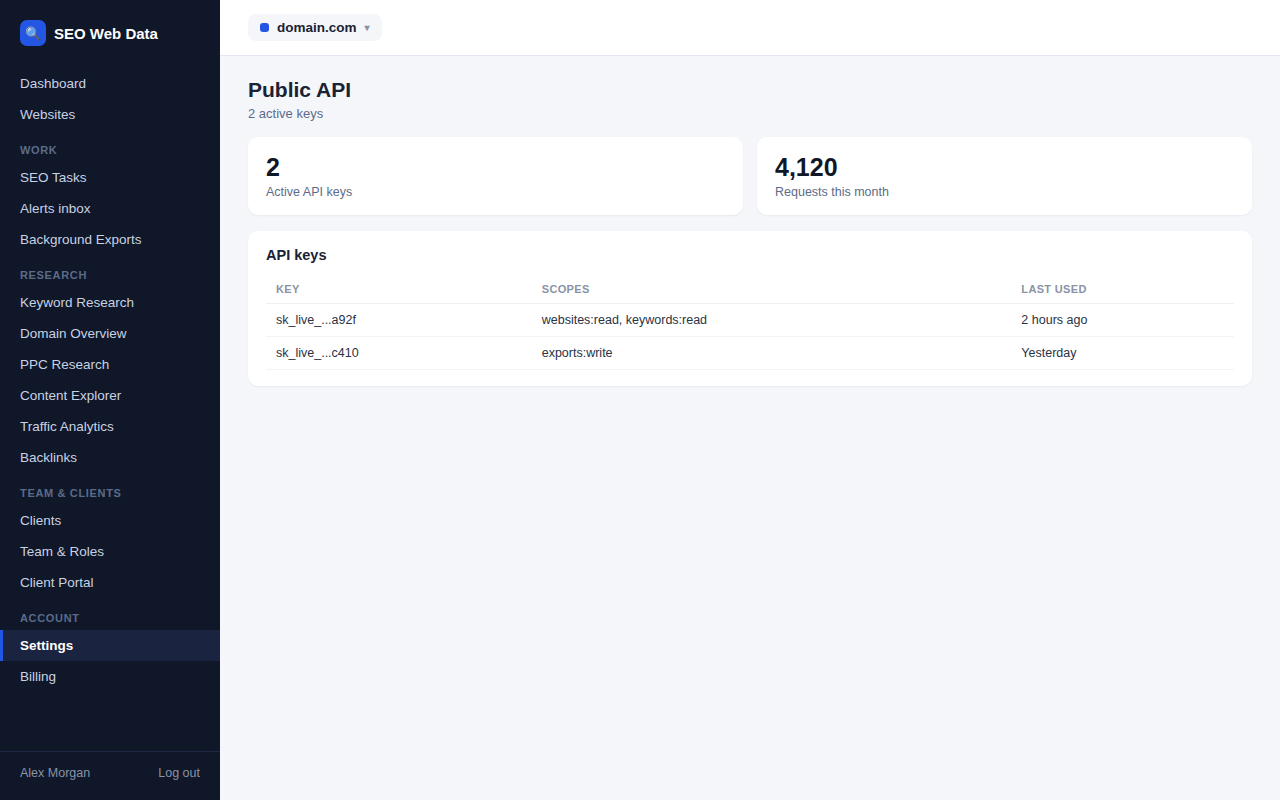
The API gives programmatic access to your own account's websites, crawl results, issues, keywords and reports, so you can pull SEO Web Data's data into an internal dashboard, a client-facing tool of your own, or any other system you already rely on. It only ever returns data belonging to your own account — there's no way to reach another account's data through it — and request allowances scale by plan.
For real-time push instead of polling the API on a schedule, pair it with webhooks; for bulk one-off pulls in a specific file format, see data exports.
Why a documented API matters
Every agency and in-house team eventually outgrows the exact dashboard views a tool ships with — a specific internal report, a combined view across tools, a client-facing widget built to match your own brand exactly. An API is what makes that possible without waiting on a feature request, building instead on data you already have access to.
- Build your own dashboards — combine SEO Web Data's data with other internal systems in whatever shape actually fits your workflow.
- Automate repetitive pulls — schedule your own scripts to fetch data on your terms, rather than manually exporting.
- Documented endpoints mean integration work doesn't start with reverse-engineering an undocumented format.
- Sandbox-friendly — documented, predictable responses make it straightforward to build and test an integration before relying on it in production.
Frequently asked questions
What data can the API access?
Your own account's websites, crawl results, issues, keywords and reports — the same data you see in the dashboard.
Are there rate limits?
Yes, request allowances scale by plan — see Pricing for current limits.
Is API access included on every plan?
Availability depends on your plan — see Pricing for details.
Is there a client library or SDK?
The API is built on standard, documented REST endpoints, so it can be used from any language capable of making HTTP requests.